The Algorithm That Won an Election Without Knowing It

[Karthik Renkarajan] · Privacy Engineer / Responsible AI & Governance
Part 1 of 3 When the Algorithm Wins the Election
A personal note before we begin: I have been a Vijay fan since Ghilli. I say that not to declare bias but to establish context — this analysis comes from inside the culture it is examining, not from outside looking in. What I saw in Tamil Nadu 2026 was not a manipulation story. It was something far more interesting: a recommendation system that accidentally built the most sophisticated political amplification network in Indian electoral history. Nobody designed it. Nobody directed it. It just emerged — fifteen years in the making.
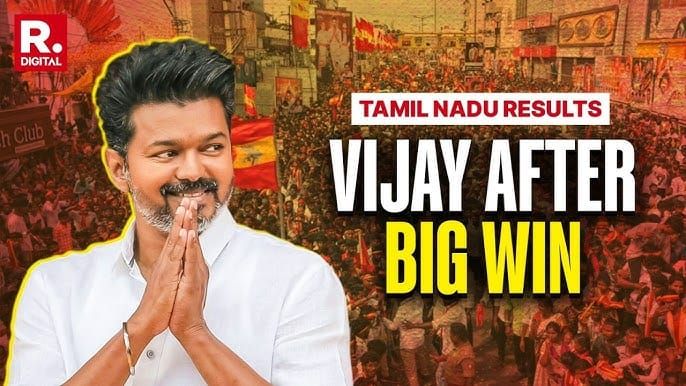
In April 2026, Tamil Nadu handed a two-year-old party 108 of 234 assembly seats — the most disruptive electoral debut in the state's modern political history. Tamizhaga Vettri Kazhagam(TVK) defeated two political machines with a combined age of over a century.
Every commentator is explaining this through anti-incumbency, Vijay's celebrity, and GenZ mobilisation. All of those are real factors. But as an AI / Privacy Engineer professional who studies how systems interact with human behaviour at population scale, I want to offer a different frame entirely.
The most important thing about TVK's digital operation is not that it was masterfully engineered.
It is that the most powerful parts of it ran on their own — without central instruction, without anyone fully understanding the mechanism, and with no one needing to give an order for it to work.
And from an AI governance perspective, that makes it far more significant than any directed campaign would have been.
The recommendation algorithms did not know it was influencing an election. It was simply doing what it was designed to do — and what it was designed to do, run for fifteen years across million Vijay fans, produced a perfectly calibrated political amplification network.— The core finding
What Emergent Coordination Actually Means
Before the analysis, one concept from complex systems research that makes everything else click.
Emergent coordination describes large-scale behaviour that looks deliberately directed but arises from many individual actors each following their own learned patterns — with no central instruction required.No bird is following orders. Each bird follows three simple rules — stay close, avoid collision, align direction — and the stunning collective behaviour emerges automatically from those individual rules interacting.
The TVK digital operation, I will argue, follows exactly this model. And understanding the mechanism is the key to understanding why it matters for AI governance globally — not just for this one election.
The Foundation: Fifteen Years the Algorithm Was Teaching
Begin not in 2024, when the party launched. Begin in 2009, when Vijay's fan clubs — eventually 85,000 of them across Tamil Nadu — first organised on digital platforms.
For fifteen years, these fans posted when Vijay released a film. They posted when he made a public statement. They posted in defense of him when criticism appeared. And over fifteen years, Social Media(Insta / Facebook / TikTok) recommendation systems did something these fans never consciously registered: it rewarded certain behaviours and penalised others.
Post within the first hour of a major announcement — more reach. Coordinate with other fans simultaneously — more distribution. Share to DM contacts — algorithmic amplification. Post late and scattered — buried, seen by almost no one.
The algorithm never sent a memo. It never held a training session. It simply rewarded early, dense, coordinated engagement and penalised late, scattered posting — consistently, across every major film release, for fifteen years. And over those fifteen years, millions of Vijay fans internalized this reward structure through direct experience.
The algorithm trained the fans. Not TVK.
The conditioning loop — running ~3–4× per year for 15 years.
1 Fan posts immediately when Vijay content drops — instinctively, because that is what fans do.
2 Algorithm reads the dense early engagement as high-quality content and pushes it to non-followers.
3 Fan sees the spike — 4,000 views instead of 200. Dopamine reward fires. Brain records: early posting = results.
4 Behaviour locks in. Next release: the fan posts immediately again — not strategically. Instinctively. The algorithm made it feel natural.
5 Social norm forms. Thousands of fans learn the same lesson independently, then reinforce it socially. The behaviour becomes fan culture — spreading even to new fans who haven't experienced enough cycles to learn it directly.
This is operant conditioning — one of the most well-established mechanisms in behavioural science, described by B.F. Skinner in the 1930s. Reward a behaviour, it happens more. Penalise it, it happens less. Eventually the behaviour becomes automatic — the fans stops thinking about it and simply does it.
Social Media platforms is Skinner's box. The fans are the subjects. But nobody designed it that way. It is an emergent property of running an engagement-optimisation system across a passionate human community for fifteen years.
When the Party Launched — The Network Was Already There
When TVK launched in 2024, something unprecedented happened. Not unprecedented for politics — fan-club-to-political-network conversion is a Tamil Nadu tradition going back to MGR / Jayalalitha (I miss her a lot) in the 1970s. What was unprecedented was the digital infrastructure those fans carried with them.
MGR's fan clubs coordinated through physical presence — pamphlets, loudspeakers, street meetings. Their coordination was visible, local, and traceable. Vijay's fans arrived in 2024 with something completely different: Millions of Instagram accounts with 10–15 year engagement histories, established follower networks, platform trust scores, and — crucially — fifteen years of unconsciously learned algorithmic behaviour that was perfectly optimised for the very thing TVK needed.
When the party launched and fans applied their existing cultural practices to political content, the algorithm responded exactly as it had been responding for years. The engagement patterns were identical. The reward followed. The reach expanded.
TVK's war room built the content engine — high-quality Reels, coordinated candidate launches, a GenZ-targeted manifesto, rally footage turned around within hours. That is skilled, deliberate work that deserves credit. But they did not need to build the distribution engine. It already existed. And it ran itself.
The key insight
TVK built the content engine. The algorithm built the distribution engine — fifteen years earlier, one film release at a time. Neither needed the other to know what it was doing.
The Kamal Haasan Question — Why Celebrity Alone Was Never Enough
The most immediate objection to this thesis is obvious: Kamal Haasan had fans too. He launched Makkal Needhi Maiam in 2018 with enormous name recognition, a sharp anti-corruption platform, and genuine star power. MNM won zero seats in 2021. Kamal lost his own constituency by 1,728 votes. The party dissolved into DMK by 2024.
This is not a counterargument to the emergent coordination thesis. It is the proof of it.
Vijay's fan network
- 15 years of coordinated digital behaviour
- Trained on social media's exact reward signals
- Mass, homogeneous, high-coordination culture
- Clear full-time commitment signal — left films entirely
Kamal's fan network
- Admired him — did not coordinate for him
- Older, more intellectual, less digitally homogeneous
- No equivalent 15-year coordination rehearsal
- No prior electoral infrastructure proof point
- Perception: one foot still in cinema
There is a second layer that the algorithm makes decisive. Kamal's political message — anti-corruption, good governance, civic responsibility — is intellectually compelling. It generates respect. What it does not generate at scale is the engagement signals that recommendation systems reward: shares, DM forwards, completed views, emotional comment threads.
Vijay's content — youth aspiration, anti-establishment energy, the idea that a new generation deserved different politics — generated those signals naturally. High completion rate. High DM share rate. High emotional comment volume. The algorithm responded accordingly.
Here is the sentence that matters most for AI governance:
The algorithms cannot tell the difference between a good argument and a bad one. It can only measure what people do — and people share emotion far more than they share intellect.
Kamal Haasan did not fail because celebrity does not translate to votes. He failed because celebrity without algorithmically trained coordination, emotional content engineering, and a committed exit from his previous identity does not produce emergent amplification. TVK had all three. MNM had none.
This Is Happening Everywhere — TN Is Just the Clearest Example
What makes Tamil Nadu 2026 globally significant for AI governance is not that it is unique. It is that it is the clearest available example of a phenomenon happening wherever recommendation systems meet passionate human communities with years of platform experience.
BTS ARMY coordinates mass-streaming within the first hour of a release — not because anyone instructed them, but because they learned algorithmically that it makes songs chart. They are a 50-million-person emergently coordinated amplification network, trained by Spotify and YouTube's recommendation systems over a decade. K-drama fandoms develop sophisticated first-hour engagement rituals around episode drops. Premier League supporter communities coordinate transfer news amplification with a precision that would embarrass most PR agencies.
Every one of these communities is, without knowing it, an algorithmically trained seed network for whoever they follow. The behaviour was trained by the platform. The community experiences it as authentic enthusiasm. Both things are simultaneously true.
The difference in Tamil Nadu 2026 is that this trained network entered a democratic election. The behaviour was identical — coordinate early, engage densely, share to DMs. The content changed from film trailers to political Reels. The algorithm responded identically, because the engagement signals were identical. And 108 seats followed.
The global governance question
Every AI governance conversation asks: how do we stop humans from using AI to manipulate elections? Tamil Nadu 2026 forces a harder question: what do we do when the AI systems already trained the humans — years before the election existed?
Why This Is Different From Everything Our Governance Frameworks Expect
Every framework we have for detecting and governing digital election influence assumes an identifiable actor with intent. A bot farm — take down the fake accounts. A foreign influence operation — follow the money. A coordinated inauthentic behaviour network — detect the posting patterns, remove the accounts.
The TVK case breaks every one of these frameworks simultaneously.
The accounts are real — millions of genuine fans with 15-year platform histories. There are no fake accounts to detect. The coordination is authentic — real people following instincts shaped over fifteen years of genuine engagement. There is no instruction to trace. The behaviour is invisible — to Social Media companies, to the Election Commission, to any researcher — because it looks, from the outside, exactly like organic democratic enthusiasm. Because it is organic democratic enthusiasm.
You cannot regulate genuine enthusiasm. You cannot prosecute emergence. The entire legal architecture of election integrity points at the wrong end of the causal chain.
And this is where the governance story gets genuinely difficult — and genuinely important. Because if authentic-account emergent coordination is indistinguishable from a directed influence operation, then we have no way of knowing, for any election, whether what we are seeing is genuine democratic expression or engineered amplification. That unknowability is itself a threat to democratic legitimacy — regardless of what actually happened in 2026.
Coming More in Part 2. Stay tuned.
Disclosure: This analysis examines TVK's digital operation as a case study in recommendation system behaviour. It does not constitute a claim of wrongdoing by TVK, its leadership, or its supporters. The governance questions raised apply equally to any party in any election that benefits from algorithmic amplification of genuine enthusiasm.